

Looking for a reliable way to find the correct breaker without guessing?

Quick Verdict
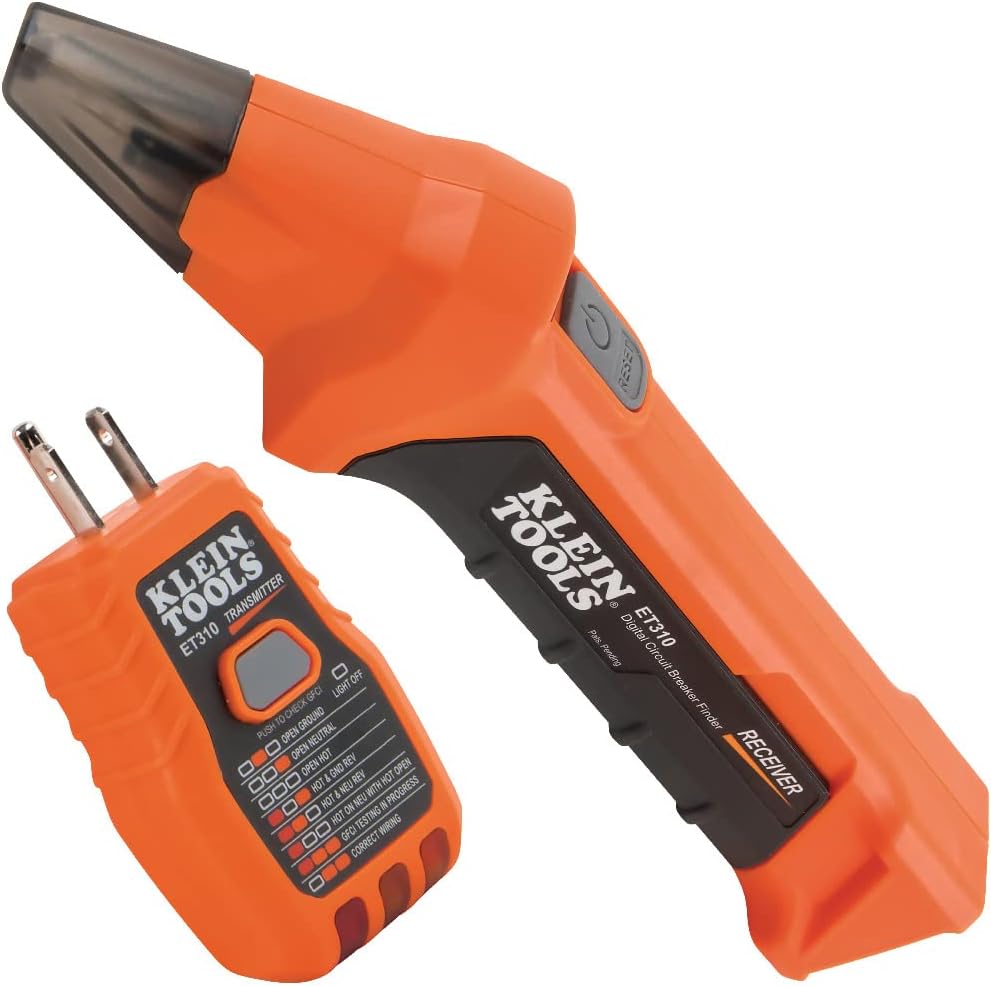
You’ll appreciate how the Klein Tools ET310 AC Circuit Breaker Finder, Electric and Voltage Tester with Integrated GFCI outlet tester simplifies the chore of identifying breakers. It’s a straightforward two-part tool that pairs a plug-in Transmitter with a hand-held Receiver to give clear audible and visual feedback when you locate the matching breaker.

Klein Tools ET310 AC Circuit Breaker Finder, Electric and Voltage Tester with Integrated GFCI Outlet Tester
$44.98 In Stock
What the Klein Tools ET310 Is
This is a purpose-built circuit breaker finder and basic wiring tester that helps you quickly identify which breaker controls a particular outlet or fixture. You plug the Transmitter into an outlet and use the Receiver to scan your breaker panel; the Receiver signals when you’ve found the correct breaker.


Who This Is For
If you do any electrical troubleshooting—whether you’re a homeowner, DIYer, electrician, or maintenance technician—this tool can speed up the job and reduce mistakes. You’ll find it especially helpful when you need to isolate circuits for repairs, label panels, or verify GFCI operation without calling a pro.
Key Features Overview
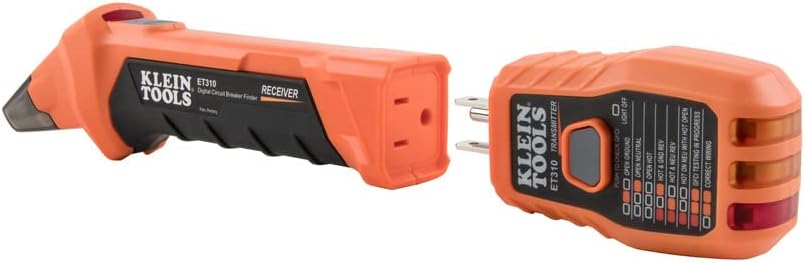
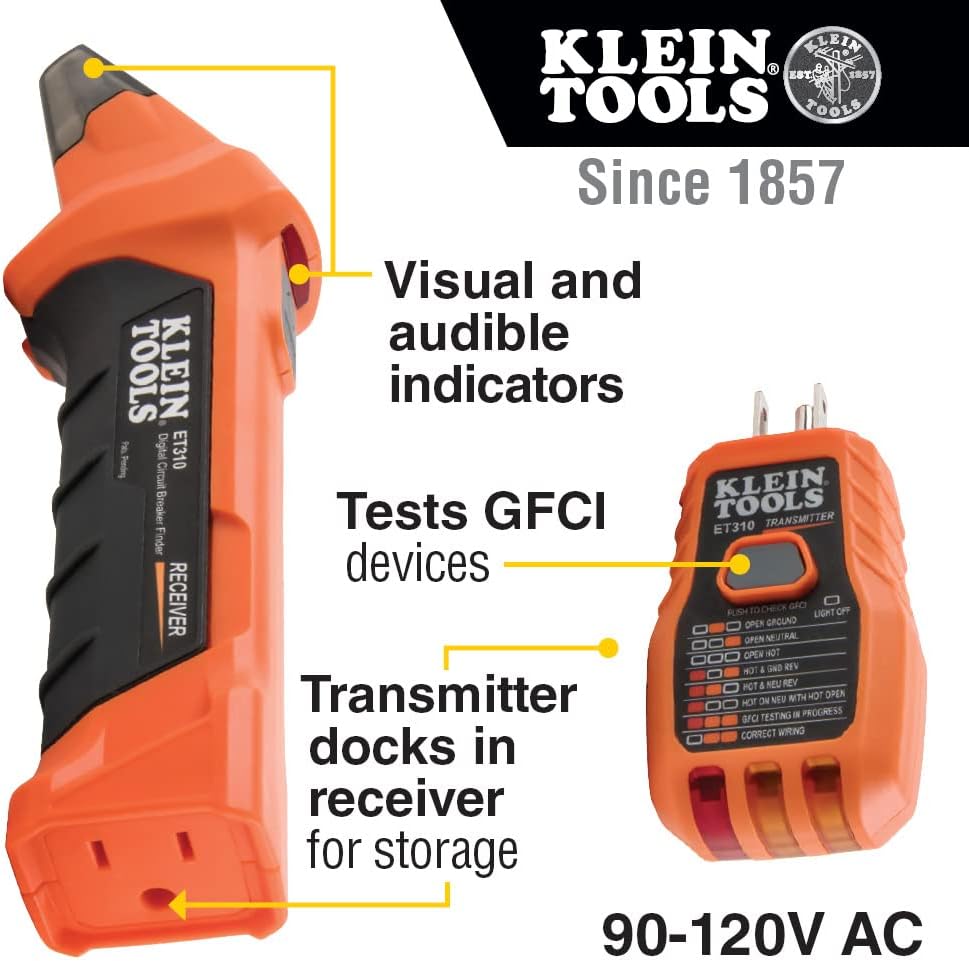
The ET310 packs a number of useful features into a compact package that’s easy to carry and operate. It offers accurate circuit identification, a two-part Transmitter/Receiver system, audible and visual target indication, compatibility with 90–120V AC circuits, and a built-in GFCI outlet tester. The Transmitter docks in the Receiver for convenient storage.
Accurate Circuit Breaker Identification
You’ll get reliable identification of the correct breaker, which reduces the time spent tracing wiring and minimizes the chance of shutting off the wrong circuit. The Receiver uses clear LED indicators and a pulsed audio tone so you can be confident once the correct breaker is found.
Two-Part System: Transmitter and Receiver
The Transmitter plugs into the outlet or connects to a fixture, and the Receiver scans the breakers at the panel. This separation avoids running wires across rooms and gives you a fast, non-invasive method to trace circuits.
Clear Indications: Visual and Audible
The Receiver provides both a visible signal (LED) and an audible tone that increases as you approach the right breaker. You’ll get an unmistakable response when you’re over the correct circuit, so you don’t have to guess.
Built-in GFCI Tester
The Transmitter includes a GFCI outlet tester so you can check wiring condition and trip GFCI devices. This adds value because you’re not only locating breakers but also confirming outlet safety without a separate tool.
Wide Compatibility (90–120V AC)
The unit is designed for standard North American residential and light commercial circuits operating from 90 to 120 volts AC. If you work in typical home or office settings, it’ll be compatible with most outlets you’ll test.
Convenient Storage and Universal Connectivity
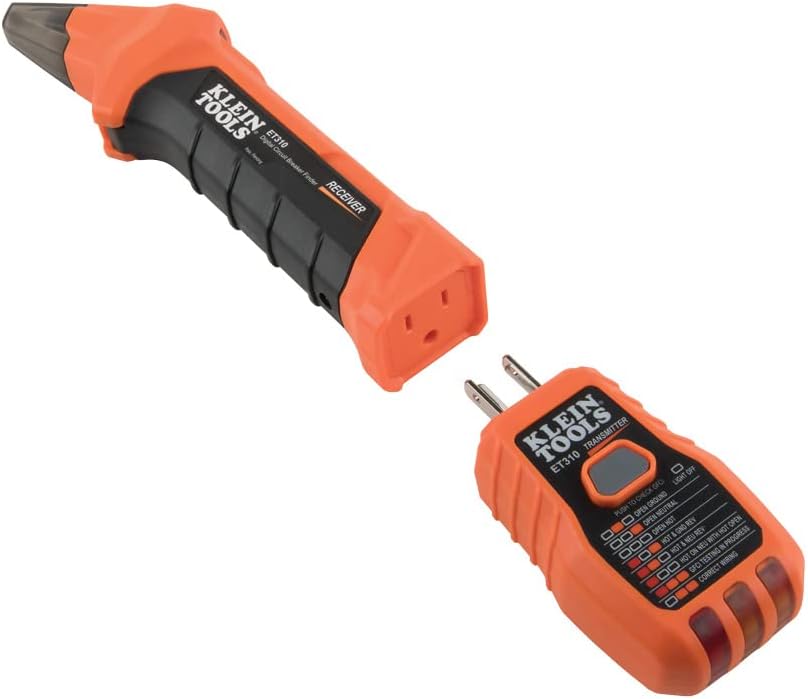
The Transmitter docks into the Receiver for compact storage, preventing lost parts and making the pair easier to transport. The Transmitter uses a three-prong plug for grounded outlets, matching North American standards for straightforward use.
Technical Specifications (At-a-Glance)
Below is a table summarizing the most important specifications and what they mean for you in practical terms.
| Feature | Details | What It Means for You |
|---|---|---|
| System Type | Two-part: Transmitter + Receiver | Plug one end into the outlet, scan breakers with the Receiver |
| Operating Voltage | 90–120V AC | Works with standard North American outlets |
| GFCI Testing | Built-in GFCI outlet tester on Transmitter | Tests wiring condition and GFCI operation without extra tools |
| Indication | Visual LED + Audible tone | Both sight and sound confirm correct breaker |
| Plug Type | 3-prong grounded plug (North American) | Fits standard grounded outlets; ensures safety and compatibility |
| Storage | Transmitter docks in Receiver | Compact storage, reduces lost pieces |
| Use Case | Homeowners, electricians, maintenance | Good for tracing circuits, panel labeling, and safety checks |
This table should help you quickly compare the main attributes and decide if the device fits your needs.
Design and Build Quality
Klein Tools has a reputation for robust, jobsite-ready equipment, and the ET310 follows that trend in terms of practical design. The Receiver feels sturdy in hand, with a grip-friendly housing that’s comfortable during repeated scans. The Transmitter is compact and unobtrusive, fitting into outlets without blocking adjacent sockets in most cases.
Ergonomics and Portability
You’ll notice the Receiver is shaped for single-hand operation and scanning across breaker rows. The Transmitter docks into the Receiver so you can carry both pieces neatly; this reduces clutter in your tool bag and lowers the chance of losing the transmitter.
Durability and Materials
Materials are selected to withstand normal jobsite handling. While this tool isn’t meant to be dropped from heights, it’s built to survive standard wear and tear—knock it around in your van or toolbox and it will generally hold up.
How to Use the ET310 (Step-by-Step)
Using the ET310 is straightforward and you can get results quickly if you follow these steps carefully. Below is a clear guide to help you avoid common mistakes and get accurate identification.
Step 1: Prepare the Outlet and Transmitter
Plug the Transmitter into the outlet or attach it to the fixture you want to trace. Make sure any connected devices are unplugged so the line is clear and stable. You’ll want the Transmitter fully inserted so it makes consistent contact.
Step 2: Turn Off Nearby Lights or Electronics That May Interfere
While the system is robust, minimizing other electrical noise around the circuit helps the Receiver give a cleaner signal. You don’t need a total power shutdown—just reduce variable loads on the circuit if possible.
Step 3: Scan the Breaker Panel with the Receiver
With the Receiver powered on, slowly pass it across each breaker in the panel. Position it closer and further until you hear the tone increase and see the LED brighten; when both peak you’ve identified the correct breaker.
Step 4: Confirm and Label
Once identified, flip the breaker to verify the outlet loses power, then label the breaker if needed. Labeling saves you time later and avoids accidental trips to the wrong breaker.
Step 5: Use the GFCI Test Function (Optional but Recommended)
Use the Transmitter’s built-in GFCI tester to test GFCI receptacles. Plug the Transmitter into the outlet and press the test button to trip the GFCI; the outlet should cut power. This confirms the GFCI is functioning properly.
Performance and Accuracy
In normal household and light commercial environments, you’ll find the ET310 gives quick and reliable results. The combination of a pulsed audio tone and LED indicator reduces ambiguity when breakers are close together in a panel.
Signal Clarity in Typical Conditions
You’ll benefit from a clean signal on most common wiring layouts. The Receiver tends to show a single stronger signal on the correct breaker rather than a confused multiple-peak readout, so you can confidently identify which breaker is associated with the Transmitter.
Common Interference and How to Handle It
If an adjacent breaker shows a weaker signal, simply move the Receiver slowly to pinpoint the strongest response. Heavy-duty equipment nearby, shared neutrals, or multi-wire branches can cause ambiguous signals; taking more time and confirming by switching breakers off briefly will help.
GFCI Testing Capability and Safety Checks
The integrated GFCI outlet tester is a real convenience because it prevents the need to carry and use a second device. You’ll be able to quickly verify wiring and GFCI operation as part of your circuit identification process.
How the GFCI Test Works
Plug the Transmitter into the outlet and use its test button to trip a GFCI. If the switch trips and restores properly, you’ve confirmed the GFCI device is operational. If it fails to trip or doesn’t restore power properly, that indicates a wiring or device issue requiring further attention.
Why This Matters for Safety
GFCI outlets protect you from ground-fault shocks, especially in wet areas. Being able to test GFCIs while identifying the circuit gives you both location and safety data in one go, which is especially useful when doing kitchen, bathroom, or outdoor troubleshooting.
Compatibility and Limitations
While the ET310 is quite useful, you need to be aware of its designed scope and limits. It’s not intended for HVAC 240V equipment, commercial three-phase systems, or non-North American voltage systems.
Voltage Range and Circuit Types
The ET310 is specified for 90–120V AC circuits, meaning it’s ideal for standard residential and light commercial outlets. If you need to trace higher-voltage circuits, three-phase panels, or 240V lines, you’ll need a different tool.
Situations That May Cause False or Weak Signals
Shared neutrals, multi-wire branch circuits, and certain panel wiring configurations can complicate readings. In these cases you’ll need to use additional verification—turning breakers off, using a multimeter, or consulting an electrician—to ensure safe results.
Pros and Cons
You’ll find the ET310 has several advantages that make it worthwhile for routine use, along with some limitations you should consider before buying.
Pros
- Accurate and easy-to-read visual and audible indicators that speed up breaker identification.
- Built-in GFCI testing adds safety verification without extra tools.
- Compact two-part system with docking for neat storage.
- Simple operation suitable for homeowners and professionals alike.
- Works with standard North American 90–120V AC outlets.
Cons
- Not suitable for 240V or three-phase electrical systems.
- May require extra verification in panels with complex wiring or shared neutrals.
- The Receiver’s sensitivity may need careful scanning technique near dense breaker arrangements.
Comparison with Similar Tools
When you compare the ET310 to other breaker finders and testers, you’ll notice differences in features, build quality, and price. The built-in GFCI tester and convenient docking are distinguishing benefits that many competitors don’t offer in a single compact unit.
Competing Models and Trade-Offs
Some competing devices may offer broader voltage ranges or advanced features like tone variability, digital readouts, or the ability to trace non-powered wires. However, those options often come at higher cost or with added complexity. If your focus is household circuit identification and GFCI testing, the ET310 is balanced and easy to use.
Cost vs. Value
You’ll likely find that ET310 delivers strong value for the jobsite or home toolbox. It’s not the cheapest option, but the convenience of integrated GFCI testing and reliable identification justifies the investment for many users.
Tips and Best Practices
To get the most consistent results from the ET310, follow these practical tips. They’ll reduce false positives and make scanning panels quicker and more accurate.
Scan Slowly and Systematically
Move the Receiver at a slow, steady pace across breakers to let the signal stabilize. Rushing can make you miss the peak indication and lead to misidentification.
Reduce Interference When Possible
Turn off large motors or heavy loads on the circuit being tested if practical. This helps the Receiver pick up a cleaner signal from the Transmitter.
Confirm by Switching Breakers
After identifying a breaker, flip it off and re-check the outlet to ensure power is actually removed. This confirms your identification and prevents accidental assumptions.
Label the Breaker Immediately
Once you find the correct breaker, take a few seconds to label it. This saves time on future work and helps other household members quickly recognize the circuit.
Troubleshooting Common Issues
If the ET310 doesn’t seem to work as expected, you can use the following steps to diagnose and correct problems. These tips will help you avoid frustration and ensure accurate results.
No Signal Detected
Check that the Transmitter is fully plugged in and that the outlet has power. If the outlet has no power, you may need to check upstream breakers or connections. Also make sure the Transmitter is not plugged into a GFCI-protected outlet that’s currently tripped.
Weak or Multiple Signals
If the Receiver shows weak or multiple signals across nearby breakers, slow your scanning speed and move the Receiver closer to each breaker to find the strongest signal. Also try removing any loads from the circuit to reduce noise.
GFCI Test Doesn’t Trip
If the GFCI tester doesn’t trip the outlet, the outlet may be faulty, or wiring could be incorrect. Confirm by testing another known-good GFCI outlet or use a separate GFCI test method. If results remain ambiguous, consult a licensed electrician.
Maintenance and Storage
You’ll extend the useful life of the ET310 by following simple care and storage practices. The integrated docking feature helps keep parts together and protected.
Battery and Power Considerations
Check and replace the Receiver batteries as needed to ensure consistent sensitivity. Store the Transmitter docked in the Receiver to prevent loss and exposure to dirt or moisture.
Cleaning and Handling
Wipe the unit with a soft, dry cloth after use. Avoid submerging it in water or exposing it to corrosive materials. Handle gently to avoid breaking internal components.
Who Should Buy the Klein Tools ET310
You should consider the ET310 if you routinely need to identify breakers for repairs, panel labeling, or safety checks in residential or light commercial settings. It’s especially suited to homeowners, property managers, contractors, and electricians who value portability and integrated GFCI testing.
Scenarios Where It Shines
- Labeling breakers during home inspection or improvement projects.
- Troubleshooting power loss to outlets and fixtures.
- Routine maintenance checks in rental properties.
- Quick safety verification of GFCI outlets during bathroom or kitchen work.
Scenarios Where It’s Not the Best Fit
If you regularly work with 240V circuits, three-phase panels, or industrial electrical systems, you’ll need a more advanced tracer suited to higher voltages and complex configurations.
Frequently Asked Questions (FAQs)
Below are answers to some of the questions you might have about the ET310. This section aims to clear up typical concerns and usage scenarios.
Can I use this on 240V circuits or international voltage systems?
No. The ET310 is designed for 90–120V AC circuits typical in North American residential and light commercial applications. For 240V or international systems, you’ll need a device rated for those voltages.
Will it work on multi-family or commercial panels?
It works on standard 90–120V panels commonly found in multi-family and small commercial buildings, but complex commercial panels with three-phase or high-capacity circuits may require specialized equipment.
What happens if the GFCI test fails?
A failed GFCI test usually indicates a wiring fault or a defective GFCI device. Stop using the outlet and consult a qualified electrician to diagnose and repair the problem.
How accurate is the Receiver when breakers are tightly packed?
Accuracy remains good, but you may need to scan slowly and confirm by flipping breakers off briefly. Tight panel layouts may produce adjacent responses; use patience and verification for best results.
Final Thoughts
You’ll find the Klein Tools ET310 AC Circuit Breaker Finder, Electric and Voltage Tester with Integrated GFCI Outlet Tester to be a very practical and well-balanced tool for routine circuit tracing and safety checks. Its two-part Transmitter/Receiver design, clear audio/visual feedback, built-in GFCI testing, and compact storage make it a solid pick for homeowners, contractors, and technicians working with standard 90–120V outlets.
If your work is mainly in residential or light commercial settings and you need a dependable, portable tool that saves time and reduces guesswork, the ET310 is worth considering. It won’t replace specialized equipment for high-voltage or commercial three-phase systems, but for everyday outlet tracing and GFCI verification, you’ll likely find it indispensable.
Disclosure: As an Amazon Associate, I earn from qualifying purchases.